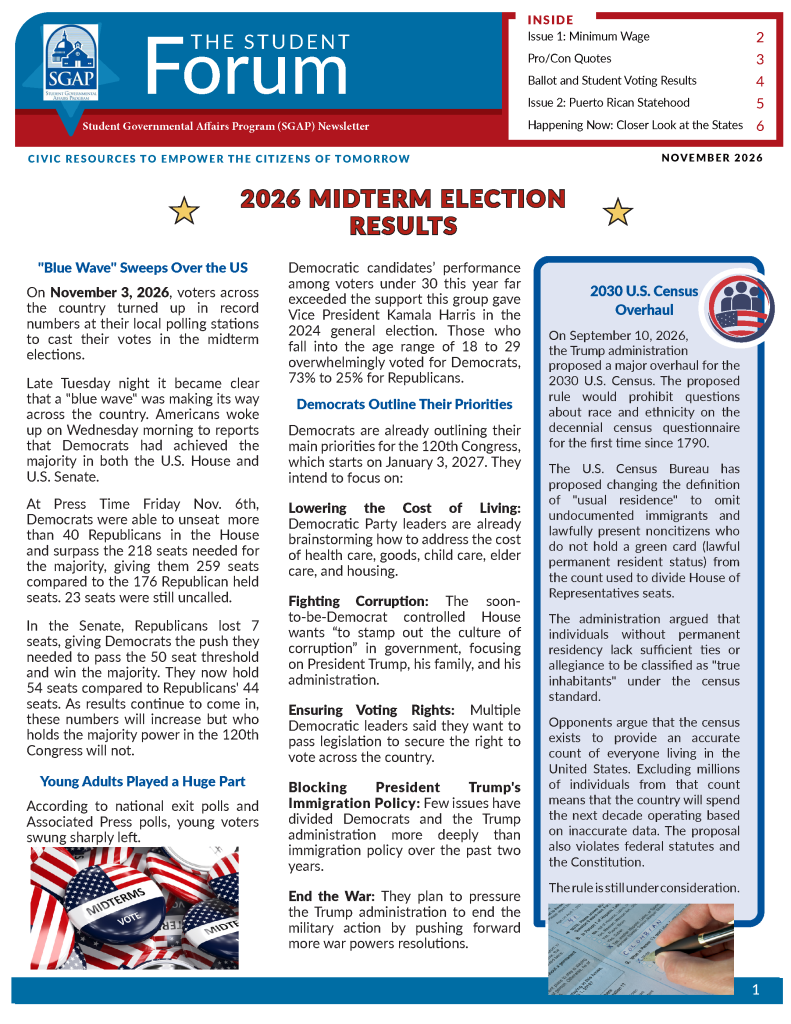
Links and Discussion Questions November 2026 – Teacher Ideas
Ideas for Teachers
November 2026 Student Forum Newsletter Issues
RESEARCH LINKS
Issue 1: $25 Minimum Wage
- Congress.gov: H.R.8555, “Living Wage for All”
- House.gov: “Workers & Labor Leaders Introduce the Living Wage for All Act.”
- Investopedia: “What Is a Living Wage? Definition, History, and How to Calculate it.”
- NAACP: “NAACP Applauds Reps. Ramirez & Mejia for Introducing Living Wage for All.”
- Competitive Enterprise Institute: “Living Wage for All Act leaves hourly workers behind”
Issue 2: Puerto Rican Statehood
- bvirtualogp.pr.gov: “Joint Resolution 66” (Starts in Spanish then translates to English)
- Council on Foreign Relations: “Puerto Rico: A U.S. Territory in Crisis.”
- NAPREC: “Champions of Puerto Rico Statehood in Congress”
- Latino Newsletter: “Republicans Once Supported Puerto Rico Statehood…”
- CNW: “Puerto Rico governor formally asks US Congress to admit territory as 51st state.”
DISCUSSION QUESTIONS
Issue 1: $25 Minimum Wage
- Do you think a minimum wage set at $7.25 an hour is sufficient to live off of?
- Would raising the minimum wage to $25 an hour help workers better support their families and pay their bills?
- Do you think a $ 25-an-hour minimum wage would harm small businesses and force layoffs?
- Should workers be paid a living wage?
- Would raising the minimum wage cause businesses to raise the cost of goods and services, making things more expensive?
Issue 2: Puerto Rican Statehood
- Should Puerto Rico be admitted as the 51st state of the United States?
- Do you think granting Puerto Rico statehood would cause a balance of power issue in Congress?
- Should Puerto Rico have the ability to vote in US elections and receive federal benefits?
- Do you think adding Puerto Rico as a state would cost the American taxpayers too much money during a time that is already plagued with high inflation?
- If the people of Puerto Rico, who are US citizens by birth, have voted to join the US as a state, should Congress stand in their way?
November 2026 SGAP Program Summary
November 2026 SGAP Program Summary
Student Forum Newsletter
Each Student Forum newsletter summarizes two timely legislative issues under discussion in Congress, presents alternative viewpoints, and includes a page of quotes from both Democrat and Republican lawmakers.
Student Voice Voting Ballot
Included with the newsletter is the Student Voice Voting Ballot, which gives students the opportunity to have their voice heard on Capitol Hill. Please ask your class to mark their ballots and return them to you.
- Please tabulate your students’ votes and send the voting results to SGAP. Visit https://www.sgap.org and select “Student Voice Vote” from the dropdown menu under the “For Teachers” You may also fax them to SGAP using the Voting Ballot Fax Sheet.
- Please send the original ballots to your elected officials in Congress. Your class may receive a letter in response from the member of Addresses are listed below. Please do not return the voting ballots to SGAP.
The Honorable
U.S. House of Representatives
Washington, D.C. 20515
The Honorable
U.S. Senate
Washington, D.C. 20510
Ideas for Teachers (Research Links & Discussion Questions)
This page features links for further study and discussion questions for students. It makes a great homework assignment or use as part of your lesson plan.
Please Submit Your Student Voice Voting Results!
After you tally your students’ votes on this month’s Student Forum newsletter issues, please report your voting results to SGAP so they will be included in the national tally published in the newsletter. If you can, please include student comments!
Visit https://www.sgap.org and select “Student Voice Vote” from the dropdown menu under the “For Teachers” tab.
The deadline to submit the November 2026 student voting results is: FRIDAY, NOVEMBER 20, 2026. Thank you!
We Want to Hear from You
Thank you for leading your students as they gain insight into America’s system of government. We are interested in hearing from you. If you have suggestions, comments, or questions, please contact us by visiting https: /www.sgap.org (the SGAP website) and using the “Contact Us” web form.
Student Forum Newsletter October 2026
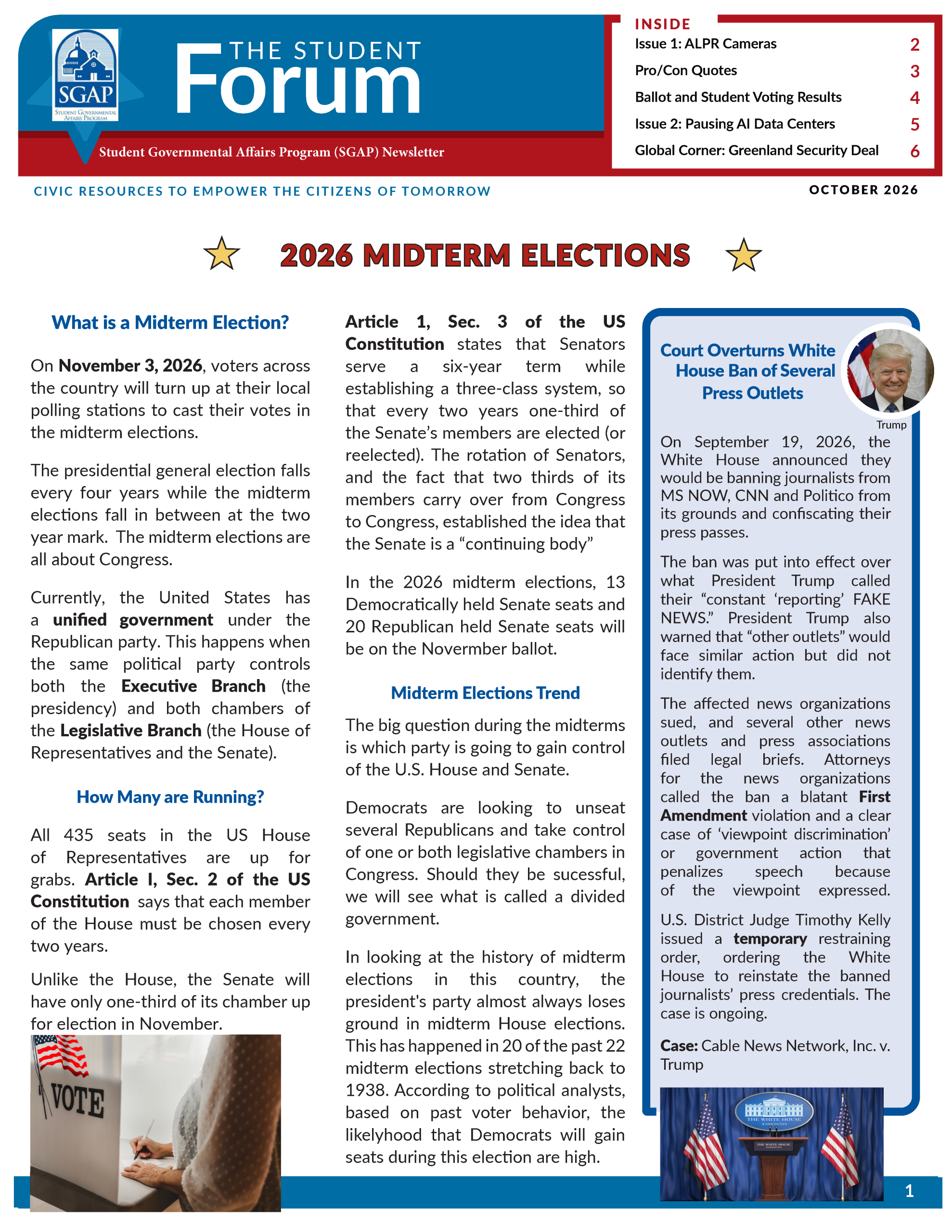
Links and Discussion Questions October 2026 – Teacher Ideas
Ideas for Teachers
October 2026 Student Forum Newsletter Issues
RESEARCH LINKS
Issue 1: ALPR Cameras
- Congress.gov: H.R.10221, “Flock-Off Act”
- House.gov: “Reps. Massie, Burlison Introduce the “Flock-Off Act…”
- ACLU: “Fight Creepy ALPR Cameras”
- Officer.com: “Texas Police Group Defends Flock Cameras Amid Privacy Concerns”
- WBTW News: “Retired FBI agent comments on nationwide Flock camera controversy”
Issue 2: AI Data Centers
- Congress.gov: S.4214, “Artificial Intelligence Data Center Moratorium Act”
- Senate.gov: “Sanders, Ocasio-Cortez Announce AI Data Center Moratorium Act”
- Barclays: “AI revolution: Meeting massive AI infrastructure demands”
- World Resources Institute: “From Energy Use to Air Quality, the Many Ways Data…”
- Brookings Institute: “Why Data Centers are Important for AI”
DISCUSSION QUESTIONS
Issue 1: ALPR Cameras
- Do you think taking pictures of cars and their drivers and storing that data is a violation of the 4th Amendment, which protects against unwarranted searches and invasion of privacy?
- Would banning federal funds from being used on ALPR cameras negatively impact police investigations?
- Do you feel information such as license plates, color, and make of vehicles should be considered private information since they are often seen on public roadways?
- Instead of banning funding for ALPRs, do you feel the government should put more regulations on their use?
- Do you believe the potential to crack down on crime by ALPRs outweighs privacy concerns?
Issue 2: AI Data Centers
- Should the government pause the building or expansion of AI Data Centers?
- Would pausing AI development cause the US to fall so far behind other nations that they would not be able to catch up?
- Do you believe pausing AI and AI data centers in the US would cause security risks as nations like China continue to develop the technology?
- Would implementing strict government regulations and oversight be a better solution to the risk AI poses?
- Do you think data centers should be able to generate their own power and recycle their own water before being brought online in US communities?
Student Forum Newsletter September 2026

Links and Discussion Questions September 2026 – Teacher Ideas
Ideas for Teachers
September 2026 Student Forum Newsletter Issues
RESEARCH LINKS
Issue 1: Congressional Term Limits
- Congress.gov: H.J.Res.12 “Proposing an amendment to the Constitution…” https://bit.ly/4qGSvPB
- House.gov: “Rep. Ralph Norman’s Introduces Constitutional Amendment…” https://bit.ly/45PHtOm
- National Constitutional Center: “Why term limits for Congress face…” https://bit.ly/45Ytp59
- Britannica: “Congressional Term Limits” https://bit.ly/45Pjoat
- Brookings Institution: “Five reasons to oppose congressional term limits” https://bit.ly/4gI2bET
Issue 2: SCREEN Act
- Congress.gov: S.737, “SCREEN Act” https://bit.ly/4gYpw6p
- Senate.gov: “Senator Lee Introduces SCREEN Act for 119th Congress…” https://bit.ly/3SFUTth
- CATO Institute: “Online Age Verification Could Create More Problems than it Solves.” https://bit.ly/4xm1qbv
- IDURA: “Age Verification on Social Media: Why It Matters.” https://bit.ly/4wYyeGO
- Harvard Law Review: “Content Neutrality for Kids…” https://bit.ly/4d7rhvH
DISCUSSION QUESTIONS
Issue 1: Congressional Term Limits
- Would limiting Congress to specific terms help to bring in new ideas that better align with voters across the country?
- Would term limits keep voters from being able to elect those they want to represent them in Congress?
- Do you think term limits would cause a loss of institutional knowledge that helps to get bills passed?
- Would term limits encourage voters to participate more in election cycles?
- Do you believe term limits should be imposed on members of Congress like they are the President?
Issue 2: SCREEN Act
- Should the government have the control to determine what is and is not harmful to children on the internet?
- Does requiring age verification pose a risk to internet users in that they are sharing data about themselves?
- Should individuals give up certain freedoms for the government to protect them better?
- Would requiring age verification help to keep minors from accessing harmful information on the internet?
- Do you think age verification will end up keeping users from accessing helpful information as well as blocking harmful sites?
Student Forum Newsletter May 2026
Links and Discussion Questions May 2026 – Teacher Ideas
RESEARCH LINKS
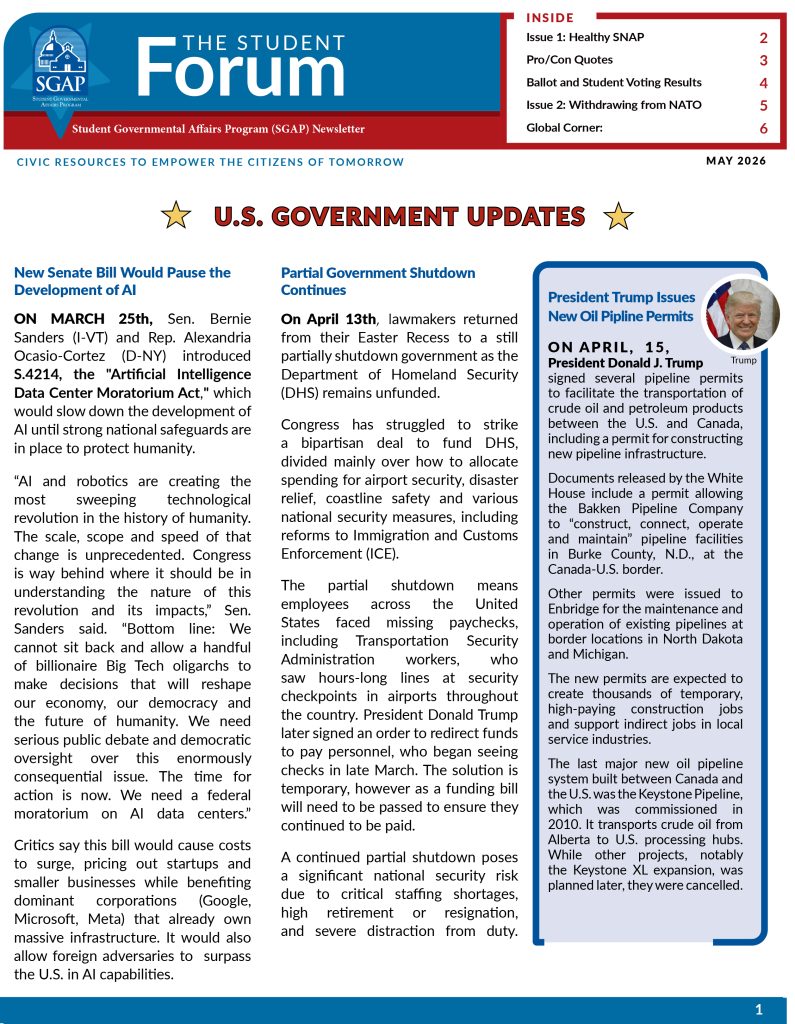
Issue 1: Healthy SNAP Act
Congress.gov: H.R.479 “Healthy SNAP Act of 2025”
House.gov: “Congressman Brecheen Reintroduces Healthy SNAP Act”
PBS.org: “Trump officials want to ban junk food from SNAP
Marketplace.org: “More states ban SNAP recipients from buying certain foods”
Brookings Institution: “Pros and cons of restricting SNAP purchases”
The Hill: “The new SNAP food restrictions aren’t just confusing — they’re illegal”
Issue 2: Leaving NATO
Congress.gov: H.R.6508, “NATO Act”
House.gov: “Rep. Massie Introduces Bill to Remove the US from NATO”
Time.com: “Leaving NATO Would Be National Self-Sabotage.”
AtlanticCouncil.org: NATO Defense Spending Tracker
Senate.gov: “Not A Trusted Organization”
Reuters: “Can Trump pull the US out of NATO?”
DISCUSSION QUESTIONS
Issue 1: Healthy SNAP Act
- Would restricting “junk food” from being able to be purchased using SNAP help to directly combat obesity, diabetes, and other chronic diseases?
- Should the government have a say in what people on SNAP can buy?
- Do you think restricting what foods SNAP recipients can buy would reduce personal choice and penalize low-income families who will no longer be allowed to buy birthday cakes for children?
- Would it encourage participants to purchase healthier alternatives which align better with the original intent of nutrition assistance?
- Do you believe that tax dollars should be restricted to purchasing nutritious food rather than products viewed as non-essential?
Issue 2: Leaving NATO
- Should Congress authorize a withdraw from NATO, an organization that many feel is outdated but other deem necessary for national security?
- Does the US pay more than its fair share into NATO?
- Should Congress withdraw from NATO and redirect military resources and focus on more crucial security threats?
- Would the US withdrawing from NATO cause global instability and lessen US influence in Europe?
- Does the US do more for NATO than members nations do for the US?
Student Forum Newsletter March 2026
Links and Discussion Questions February 2026 – Teacher Ideas
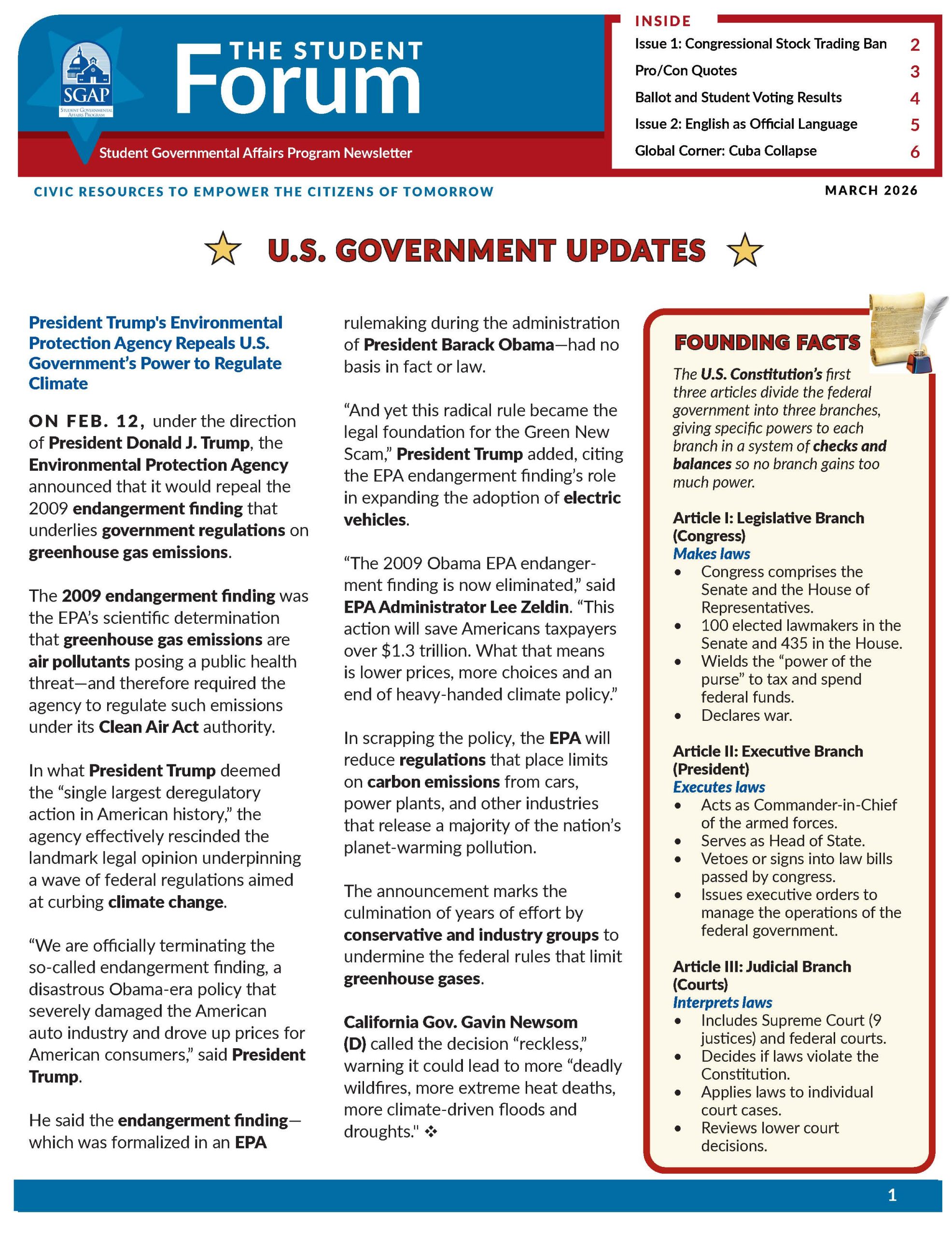
RESEARCH LINKS

ARTIFICIAL INTELLIGENCE (AI) chatbots and companion applications have become increasingly popular, offering everything from entertainment to emotional support.
Issue 1: Voter ID Law
Congress.gov: H.R.22, “Safeguard American Voter Eligibility Act” or “SAVE Act”
Alliance for Civic Engagement: “Pros and Cons of Voter ID Laws”
National Conference of State Legislatures: “Things to Know About the SAVE Act”
League of Women Voters: “What’s So Bad About Voter ID Laws?”
White House.gov: “Preserving and Protecting the Integrity of American Elections”
Constitution Center: “Understanding Voter Registration Changes Proposed Congress”
Issue 2: AI Chatbots
Congress.gov: S.3062, “GUARD Act”
Senate.gov: “Senator Hawley Introduces Bill Protecting Children from AI Chatbots”
Electronic Frontier Foundation: “Surveillance Mandate Disguised as Child Safety”
RAINN.org: “Congress Introduces RAINN-Backed AI Chatbot Bill to Protect Children”
Center for Democracy & Technology: “Reasons to Be on Guard About the GUARD Act”
The Beckage Firm: “GUARD Act: Congress Moves to Regulate AI Chatbots for Minors”
DISCUSSION QUESTIONS
Issue 1: Voter ID Law
- Given that non-citizen voting is already illegal and rare, is a national documentary proof-of-citizenship requirement a “common sense” security measure or an unnecessary solution to a minor problem?
- Proponents of the SAVE Act argue that a voter ID law would increase public confidence, while opponents say it would suppress voter turnout. Which outcome is more critical for a healthy democracy: absolute security or maximum participation?
- If passed, the SAVE Act would require American citizens to produce documents like a passport or birth certificate to register to vote. Do you feel this measure would strengthen or weaken Americans’ voting rights?
- How should lawmakers address the fact that millions of eligible citizens (including seniors, students, and low-income individuals) lack easy access to birth certificates or passports?
- Opponents of the SAVE Act say it is an example of congress using its authority to create needless obstacles for voters. Do you agree? Why or why not?
Issue 2: AI Chatbots
- Should the government implement a total ban on AI companions for minors to prevent emotional manipulation, or does this unfairly restrict access to beneficial tools, such as AI tutors and chatbots designed for friendship, therapy, or emotional connection?
- The GUARD Act requires “commercially reasonable” age verification, often involving government IDs or biometric data. Is the risk of children being harmed by unregulated chatbots significant enough to justify a “surveillance” mandate that requires all users to provide sensitive personal identification to AI companies?
- Should congress pass a single federal law like the GUARD Act to provide consistency for tech companies, or should states be allowed to experiment with different regulatory models?
- What is your experience with using generative AI or AI chatbots as a teen? Do you feel the GUARD Act is needed? Why or why not?
- What are the arguments for and against congress passing the GUARD Act? Which position do you agree with? Why?
Student Forum Newsletter February 2026